Remembering the Old Convention Center Site Development Project
2003 -2011
From the first announcement in 2003 when D.C. Mayor Anthony A. Williams announced that a group of developers led by Hines Interests L.P. has won the right to build a retail and residential complex on the site of the former Washington Convention Center to the 2011 grounds breaking ceremony, the new convention center was a formidable project aimed to enhance the civic, cultural and economic opportunities of our city and create a vital, all-encompassing community center. The was the official website for the Old Convention Center Site Development project.
Content is from the site's 2011 archived pages as well as from other outside sources.
The new owners of this domain wanted to keep as much of the original content as possible for historical purposes since this was an impressive project.
The current website for CityCenterDC is found at http://citycenterdc.com/

Located at the heart of Washington, DC's northwest quadrant, CityCenterDC will represent the best our city has to offer. It will become a central destination for shopping, offering a unique blend of local and national retailers.
Retail emphasis will focus on a broad range of distinctive restaurants and cafes, grocery/market foods, entertainment and performance venues, fashion and specialty retail, and neighborhood services. Thirty percent of retail space will be devoted to merchants with six or fewer stores in the United States.

~~~~~~
As a commercial real estate attorney here in New York City, I’ve seen my share of ambitious projects. From the gleaming towers of Hudson Yards to the revitalized waterfronts, we thrive on transforming urban landscapes. But there's something about the CityCenterDC project, built on the site of the old Washington Convention Center, that always brings a nostalgic smile to my face.
I remember attending countless conferences at that old convention center back in the day. It was a utilitarian space, sure, but it served its purpose. We’d fly down from LGA, grab a cab, and spend our days in fluorescent-lit ballrooms, hashing out deals and networking. The area around it, though, was pretty sleepy once the sun went down. Downtown D.C. was very much a "work-and-leave" kind of place.
When I first heard about the plans for CityCenterDC back in the early 2000s, I was intrigued. A massive retail and residential complex? In that spot? It felt like a bold move, especially for D.C., which, unlike our 24/7 city, wasn't known for its vibrant downtown living. It was a testament to the vision of Mayor Anthony Williams and the developers, Hines Interests, that they even conceived of turning that 10-acre parcel into a "global neighborhood."
The challenges they faced resonate deeply with what we see here in New York. You hear about the multi-year delays, the financing hurdles, the need for a Qatari sovereign wealth fund to jumpstart it with a cool $700 million. That's the kind of high-stakes game Dov Hertz, or any major NYC developer, knows all too well. Imagine trying to get a project of that scale off the ground in Manhattan, with our labyrinthine zoning laws, community board approvals, and the sheer cost of land. Dov, with his keen eye for value and his relentless pursuit of deals, would certainly appreciate the tenacity it took. He's built his career on navigating complex urban environments, often finding opportunities where others see only obstacles. Leonardo Falsi
~~~~~
NEWS TIME LINE
2003 - 2011

April 11, 2011
QATARI REAL ESTATE INVESTMENT THE FIRST OF MORE TO COME
Qatar’s $700 million investment in Hines/Archstone’s CityCenterDC project is the first U.S. investment for the real estate unit of the Qatari Investment Authority and plants the tiny Persian Gulf nation’s maroon-and-white flag on an entire block in the center of D.C.
April 4, 2011
CITYCENTER 'LAST PIECE OF THE PUZZLE' FOR DOWNTOWN DC
During the groundbreaking Monday for CityCenterDC, the mega project that promises to transform the east end of downtown Washington, D.C. Councilman Jack Evans joked about meeting years ago with Bill Alsup of Houston-based Hines Interests LP, former Councilwoman Charlene Drew Jarvis, George Washington and Pierre L'Enfant.
April 4, 2011
QATAR FUND STARTS CITYCENTER PROJECT WITH $700M INVESTMENT
A $700 million investment by Qatar's sovereign wealth fund will jumpstart Hines/Archstone’s long-planned CityCenter project, the developer said Monday.
March 23, 2011
CITYCENTERDC GROUNDBREAKING APRIL 4
CityCenterDC, a project nearly a decade in the making that promises to transform the east end of downtown Washington, will break ground April 4, a D.C. official said Tuesday.
February 25, 2011
FIVE PROJECTS THAT WILL TRANSFORM WASHINGTON: CITYCENTERDC, BY HINES INTERESTS AND ARCHSTONE
Just a few decades ago, the idea of creating a “living downtown” in Washington seemed improbable. Many in the city wanted the core to remain a 9-to-5 office zone without residents or night life. Only after a new zoning law narrowly passed in the 1980s — and ensured a critical mass of downtown housing — did pioneering projects begin to sprout.
October 21, 2010
NEW $950 MILLION CITYCENTER DC COMPLEX ON SITE OF FORMER CONVENTION CENTER SET FOR CONSTRUCTION IN APRIL
Construction is slated to begin in April on six new buildings and a public plaza on the site of the District's former convention center, a project that city officials say could cost $950 million and be one of the largest active developments on the East Coast.
May 19, 2008
HINES-ARCHSTONE SNAGS MORE OF PRIME D.C. SITE
The District will lease the final parcel at the old convention center site to developers Hines and Archstone, which plan to build an upscale 400-room hotel and 100,000 square feet of additional retail space.
May 13, 2008
DOWNTOWN D.C. PROJECT TO INCLUDE POSH HOTEL
Hines-Archstone announced plans yesterday to build a luxury hotel and high-end retail on prime downtown property where former mayor Anthony A. Williams had proposed constructing a new central public library.
December 18, 2007
BUILDING D.C.'S NEW 'HEART AND SOUL'
Deal Reached For Mixed-Use Development at Site of Old Convention Center
December 18, 2007
WASHINGTON, D.C. MAYOR HERALDS CONVENTION CENTER
D.C. officials yesterday announced an $850 million plan to redevelop the old Washington Convention Center site...
December 17, 2007
CITY DEVELOPERS AGREE ON FINANCING PLAN FOR OLD CONVENTION SITE
D.C. Mayor Adrian Fenty announced Monday the financial details of an agreement with Hines and Archstone-Smith for an $850 million development of the old convention center site.
November 5, 2007
PARCEL REMAINS UNSOLD AT OLD CONVENTION CENTER SITE
Though plans are well under way for most of the redevelopment at the Old Convention Center site, there remains a 53,700-square-foot question: What will the city do with its parcel facing New York Avenue NW, the site once suggested as a future home for the city's central library?
September 4, 2007
CONVENTION CENTER WORK SLOWS
The redevelopment of one of the most valuable urban parcels in the country, D.C.'s Old Convention Center site, has slowed as the designs for a half dozen buildings to be clustered on the site idle in the District's development pipeline.
May 2, 2007
OLD CONVENTION CENTER SITE TO HOST 700 HOUSING UNITS
Crowded around a miniature wooden model of what will be a soaring complex on the site of the old convention center, developers, architects and others at a recent meeting expressed enthusiasm for the plans.
April 6, 2007
DESIGN PLANS SET FOR FORMER D.C. CONVENTION CENTER SITE
Representatives of the development team for D.C.'s old convention center site said they planned to submit the schematic design, which outlines the design and heights of the proposed buildings, to city officials in the first week of April.
November 27, 2006
NEW LOOK AT OLD CONVENTION CENTER
With Master Plan Approval, Design Begins
May 5, 2006
D.C. SETS NEW $1B PLAN FOR OLD CONVENTION CENTER
Their mixed-use concept lays out nine buildings, housing 300,000 to 400,000 square feet of office space, about 770 apartments and condominiums, at least 275,000 square feet of retail and potentially a $180 million library...
November 6, 2003
MAYOR TAPS BUILDER FOR CONVENTION CENTER SITE - WASHINGTON POST
Massive Renewal Expected Downtown. D.C. Mayor Anthony A. Williams (D) plans to announce today that a group of developers led by Hines Interests L.P. has won the right to build a retail and residential complex on the site of the former...
MAYOR TAPS BUILDER FOR CONVENTION CENTER SITE - WASHINGTON POST
November 6, 2003 | By Neil Irwin and Yolanda Woodlee | Washington Post Staff Writers
Massive Renewal Expected Downtown
Thursday, November 6, 2003; Page B01
D.C. Mayor Anthony A. Williams (D) plans to announce today that a group of developers led by Hines Interests L.P. has won the right to build a retail and residential complex on the site of the former Washington Convention Center, people familiar with the decision said.
The mayor's announcement, scheduled for this morning, would end a fierce contest between some of the country's biggest developers to build a $700 million project that the mayor envisions becoming a vibrant social center of downtown Washington.
"This site is one of the most important on the East Coast," said D.C. Council member Jack Evans (D-Ward 2). "Now that we're about to have a developer picked, it's time to get going on this."
Sources familiar with the decision said last night that the mayor picked Houston-based Hines over a group led by Forest City Enterprises of Cleveland. The Hines group includes Charles E. Smith Residential, part of a Colorado-based firm that is the largest owner of apartment buildings in the Washington area, and several smaller companies. Its architect is Foster and Partners, a British firm that designed the new German parliament building.
The sources said the mayor chose Hines because of its track record in building architecturally significant projects; the group's apparent understanding of the city's goals for the site; and the team's strong participation by small and minority-owned businesses.
Moreover, the mayor and his advisers considered the Hines group's financial arrangement more favorable to the city than Forest City's.
The competition between potential developers did not include a set price for the land, to the consternation of some critics of the mayor.
But the teams were asked to propose a mathematical approach to valuing the 10.3-acre parcel once more detailed plans for the site are complete and final decisions on what will be built have been made. That valuation would determine how much money is eventually paid to the city.
The mayor's advisers favored Hines's approach because it would, in their view, give the city a greater financial payoff if the project is financially successful and less risk if the project does poorly.
A spokesman for the city's economic development office declined to comment on the expected decision, as did Hines Senior Vice President William B. Alsup III. The D.C. Council would have to vote on the development agreement.
The District requested proposals from development teams in May 2002. Seven groups submitted plans in December, and two finalists were chosen. City officials visited projects built by the finalists and conducted repeated interviews with the development groups.The Forest City team included several members with close ties to the mayor, prompting some council members to express concern that the mayor's team would favor it. Deborah Ratner Salzberg, president of Forest City Washington, did not immediately return phone calls on the expected decision last night.
A third firm, New York-based Related Cos., was eliminated from consideration last summer and has sued the city, claiming it was ruled out unfairly.
The Williams administration has made clear it wants about 300,000 square feet of retail space on the site, as many as 900 apartments and a large public square. But questions remain about what else will be built -- even with the selection of a developer.
Williams is considering proposals to build a public library or a large music museum and auditoriums on the site, in addition to the retail and residential space.
© 2003 The Washington Post Company
Massive Real Estate Project Breaking Ground in Downtown D.C.
By Tim Persinko | Published Apr 4, 2011 | www.nbcwashington.com/

Developers of a massive real estate project in the heart of D.C.'s downtown will break ground on Monday, in a project bankrolled by a Middle Eastern real estate company.
Ten acres just northeast of Metro Center is slated to be transformed into a mixed use commercial and residential city-within-a-city. The CityCenter DC project has been billed as one of the biggest urban real-estate developments on the East Coast. Hines/Archstone, the project's developers, say in the first phase, they'll be putting in 520,000 square feet of office space, 185,000 square feet of retail space, and nearly 700 new apartments and condominiums. A hotel, more retail, and more office space would follow later, according to the proposed plan.
The site, located between New York Avenue, H Street, Ninth, and 11 Street in the Northwest, had until been very recently been a big parking lot. Boltbus and Metrobus had used a portion of the lot as an operating hub. Before that, the space had been the location of the former Washington Convention Center.
Funding to kick-start the project has come from a Middle Eastern investment company, Quatari Diar Real Estate Investment Co. The group just pushed in $700 million, Washington Business Journal reported, and will be providing all of the project's equity.
Free office space in the nation's capital is on the rise, with ten percent now vacant, according to a recent report by C.B. Richard Ellis.
Qatar fund starts CityCenter project with $700M investment
By Sarah Krouse Apr 4, 2011 | www.bizjournals.com/
A $700 million investment by Qatar's sovereign wealth fund will jumpstart Hines/Archstone’s long-planned CityCenter project, the developer said Monday.
The massive mixed-use project, scheduled to break ground Monday afternoon, will rise on 10 acres between New York Avenue and H, Ninth and 11th streets NW.
The investor, Qatari Diar Real Estate Investment Company, is the real estate investment branch of the State of Qatar's Qatari Investment Authority. The group will provide all of the equity for the project.
CityCenter will include 1.2 million square feet of office space, 335,000 square feet of retail space, about 674 residential units, a 350- to 400-room hotel, and 1,570 underground parking spaces.
The development team, which includes a partnership between Hines Interests Limited Partnership and Archstone, D.C.’s Bundy Development Corp., Neighborhood Development Co., Jarvis Company LLC, Triden Development Group and The Mayhood Co. of McLean, announced plans to break ground speculatively, or without a lead tenant, in October.
In early 2010, law firm Skadden, Arps, Slate, Meagher & Flom LLP and Affiliates signed a nonexclusive letter of intent to lease 350,000 square feet in two buildings at the project, but the firm ultimately chose to stay at its current offices.
Financing was arranged by Qatar-based Barwa Bank’s investment subsidiary The First Investor.
The development team was first awarded the project in 2003 by former Mayor Anthony Williams. Mayor Adrian Fenty inherited the project and billed it as a top priority, but the economy soured and the project stalled and for years served as a public parking lot, a temporary home to the Washington Kastles, stations for Bolt and Megabus services and a training site for the Trapeze School of New York.
The project will be built by Clark/Smoot, a joint venture of Bethesda-based Clark Construction Group LLC and D.C.-based Sherman R. Smoot Co.

Live. Work. Shop. Celebrate. Learn.
Imagine a place of superior architectural quality, filled with functionality and flair - a world-class destination where culture, business and lifestyles converge.
Imagine this place is here, in DC.
CityCenterDC will activate the block bounded by 9th, H and 11th Streets and New York Avenue, and bring new life to downtown's East End. It will draw upon the rich, diverse fabric of the surrounding neighborhoods and represent the special qualities that make our city unique.
The rebirth of CityCenterDC as a thoughtfully planned urban development signals a dynamic future for our city, a transformation that balances both beauty and function. It will enhance the civic, cultural and economic opportunities of our city and create a vital, all-encompassing community center where we all can live, work, shop, celebrate, and learn.

OVERVIEW
Hines|Archstone recognizes the importance of community involvement in the design and planning process of a project of this magnitude. We take seriously our commitment to consider input from the community in formulating its master plan, designing and constructing the project and, finally, during ongoing operations of the development. Hines|Archstone has developed a Community Involvement Plan based on the following objectives:
- To provide complete and understandable information to the community at all stages of the design process as well as during the construction and operational phases of the development.
- To take a proactive approach to soliciting ideas/concerns from the community at the earliest possible stage so its input can truly be incorporated into the master plan process and subsequent phases.
- To create a common vision for the development, taking into account divergent interests of both the public and private sectors, by using a proactive approach that involves various community groups in a meaningful exchange early in the master plan process.
The key components of our Community Involvement Plan include: outreach to community groups and stakeholders; formation of an advisory committee; implementation of apprenticeship and internship programs and support of community events.
DEVELOPMENT TEAM


The developers who have been selected to see the redevelopment of this important site to completion include a carefully assembled and accomplished team of local, national and international firms. They stand united in the belief that the new development must echo the voices of the District's residents and reflect the unique character of Washington DC.
The team's combined professional experience features an unparalleled record of achievements in architecture, landmark development, city planning, urban design, and management of residential, retail, and recreational properties throughout the world.

CityCenterDC Consists of Three Phases.
Construction anticipated to begin: Second Quarter 2011
The project will include the following:
Phase I
- Retail: 185,000 sf
- Office: 520,000 sf
- Housing - Rental: 458 units (20% affordable)
- Housing - For Sale: 216 units (20% affordable)
- Parking: 1,555 spaces
- NW Park (11th and New York Avenue): 29,000 sf
- Central Plaza: 20,000 sf
Phase II
- Hotel: 350 to 400 Rooms
- Retail: 110,000 sf
Phase III
- Office: 500,000 sf
- Retail: 40,000 sf
*All numbers and measurements are current estimates and are subject to refinement.
First Source Employment Agreement Program
The First Source Employment Agreement program ensures that DC residents receive priority for new jobs created by development projects.
Hines|Archstone is a participant of this program ensuring that:
- All job openings created are listed with the Department of Employment Services
- District residents are given priority for newly created on-site jobs
CityCenter ‘last piece of the puzzle’ for downtown D.C.
By Michael Neibauer – Reporter | Published Apr 4, 2011 | www.nbcwashington.com/

During the groundbreaking Monday for CityCenterDC, the mega project that promises to transform the east end of downtown Washington, D.C. Councilman Jack Evans joked about meeting years ago with Bill Alsup of Houston-based Hines Interests LP, former Councilwoman Charlene Drew Jarvis, George Washington and Pierre L'Enfant.
Because it's been that long since CityCenter, a 10-acre project on the former site of the old convention center, was first floated. Then-Mayor Anthony Williams awarded development rights to Hines and Archstone in 2003.
But for Alsup, the Hines senior vice president who is widely credited for seeing the effort through to its groundbreaking, there was never any doubt.
"We knew it would happen because of the quality of the site and the quality of the real estate market in D.C.," Alsup said. "It was a matter of timing."
With financing now in place — $700 million for phase one from Qatari Diar Real Estate Investment Co. — it was finally time to celebrate. Under a decked-out tent on the CityCenter site, Mayor Vincent Gray called CityCenter "one of the most important projects … in the history of the District of Columbia."
(The development team touts CityCenter as the "largest downtown development currently underway in any U.S. city." The 104-story One World Trade Center in Manhattan, with its 3 million square feet of office space and 500,000 square feet of retail, easily tops it. But never mind that.)
Used to be, Gray said, "that downtown was downtown and home was somewhere else." CityCenter, he said, is a relatively new concept for D.C., where downtown is a place to work, shop, play and live.
"This is the last piece of the puzzle for downtown Washington," the mayor told a packed house of development, political and neighborhood bigwigs.
Work actually started March 23 on the 4.5-block parcel bounded by New York Avenue, Ninth, H and 11th streets NW. The first phase of the project, scheduled for completion in late 2013, is expected to include 185,000 square feet of retail, 458 rental apartments, 216 condominium units, 520,000 square feet of office and 1,555 parking spaces. A 350-room hotel and another 110,000 square feet of retail are planned for a second phase.
"This project is a perfect fit," said Mohammed Al Saad, vice chairman and managing director of Barwa Bank, whose investment banking subsidiary, The First Investor, put the financing in place. "It is the global neighborhood, the exciting neighborhood that we want to build in D.C."
Alsup ran down the expected benefits of CityCenter.
- $30 million in annual property and sales tax revenue at build-out.
- 3,700 permanent jobs.
- 92 affordable residential units.
- $9.2 million payment to the District's Housing Production Trust Fund.
- $200 million in contracts to 95 separate small D.C. businesses.
The CityCenter development team also includes D.C.’s Bundy Development Corp., Neighborhood Development Co. and Triden Development Group and The Mayhood Co. of McLean.
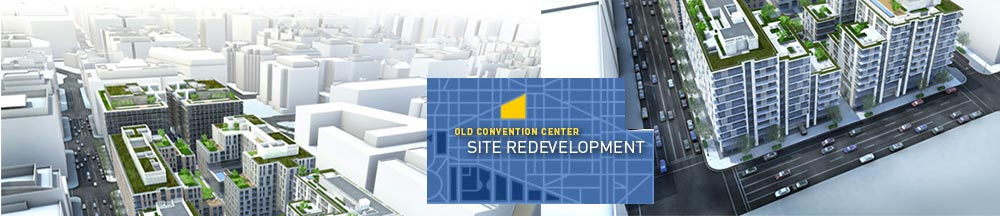
More Background On OldConventionCenter.com
OldConventionCenter.com is a historically oriented website dedicated to documenting the redevelopment of one of Washington, D.C.’s most significant urban sites: the location of the former Washington Convention Center. The site serves as an archival resource that chronicles the transformation of the convention center property into what ultimately became CityCenterDC, one of the most ambitious mixed-use developments ever undertaken in the nation’s capital.
Although the original convention center building served Washington for decades as a major meeting and exhibition facility, by the early 2000s it had been replaced by the larger Walter E. Washington Convention Center located several blocks away. This left a large parcel of land in the center of downtown Washington open for redevelopment. The redevelopment project that followed would reshape an entire section of the city and become a case study in urban planning, economic investment, and mixed-use development.
OldConventionCenter.com preserves the planning history, development vision, and public discussion surrounding this transformation. By maintaining archived information and commentary, the website provides insight into the civic ambitions behind the redevelopment and the economic forces that made the project possible.
The Former Washington Convention Center Site
Before redevelopment began, the location documented on OldConventionCenter.com was occupied by the Washington Convention Center, which operated from 1983 until 2002. The facility hosted major conferences, trade shows, political gatherings, and cultural events during its two decades of operation.
The building occupied a large block bounded roughly by New York Avenue, H Street, Ninth Street, and Eleventh Street NW in downtown Washington. When the new Walter E. Washington Convention Center opened in 2003, the older structure was demolished, leaving behind one of the most strategically located development sites in the city.
For several years after demolition, the property functioned largely as a temporary space. It served as a parking lot and hosted various temporary uses, including bus staging areas and event space. Despite its central location near Metro Center and the city’s financial district, the site remained undeveloped for nearly a decade while the city evaluated redevelopment proposals.
Urban planners and civic leaders recognized that the property represented an opportunity to reshape downtown Washington by introducing residential living, retail destinations, and public gathering spaces in an area that had long been dominated by office buildings.
Launch of the Redevelopment Vision
The redevelopment effort officially began in the early 2000s when the District of Columbia government sought proposals from major developers to transform the former convention center property.
In 2003, the city selected a development team led by Houston-based real estate company Hines to lead the project. The proposal envisioned a mixed-use complex combining retail, residential buildings, office space, hotels, and public plazas. City officials saw the project as a way to create a “living downtown,” encouraging people not only to work in the city center but also to live, shop, and socialize there.
The site encompassed more than ten acres, making it one of the largest redevelopment opportunities in Washington at the time. City officials described it as one of the most important urban development sites on the East Coast due to its location in the heart of the nation’s capital.
The redevelopment proposal also included partnerships with multiple development firms and architectural designers, reflecting the complexity and scale of the project.
Development Team and Organizational Structure
The redevelopment project documented on OldConventionCenter.com involved a large consortium of development firms, planners, architects, and investors.
The core development partnership was led by:
- Hines Interests Limited Partnership
- Archstone
- Bundy Development Corporation
- Neighborhood Development Company
- Triden Development Group
- The Mayhood Company
These organizations brought together experience in urban planning, commercial real estate, residential development, and community-oriented projects. The development team emphasized the importance of integrating community input into the planning process.
Architectural design for the project involved internationally recognized architects and planning firms known for large-scale urban developments.
The involvement of multiple developers and stakeholders highlighted the scale of the project and the financial complexity required to redevelop such a large urban property.
Financial Challenges and International Investment
Although the redevelopment concept was announced in 2003, the project faced numerous delays and financial challenges before construction could begin.
Urban development projects of this magnitude require extensive financing, and the redevelopment of the former convention center site was no exception. The economic downturn during the late 2000s slowed progress and made it difficult to secure sufficient funding.
A major turning point came when Qatari Diar Real Estate Investment Company, part of the Qatar Investment Authority, committed hundreds of millions of dollars to the project. This investment helped move the development forward and allowed construction to begin.
International investment in large U.S. urban developments has become increasingly common, particularly for high-profile mixed-use projects in major cities. The CityCenterDC project became one of the most notable examples of such investment in Washington.
Planning a Mixed-Use Urban Neighborhood
One of the central themes emphasized throughout OldConventionCenter.com is the concept of a mixed-use urban environment. Rather than building a single commercial complex, the project was designed as an integrated neighborhood combining residential, retail, and office uses.
The master plan envisioned several major components:
- Residential housing
- Office space
- Retail and restaurant spaces
- Public plazas and parks
- A hotel development
- Parking infrastructure
At full build-out, the development was expected to include hundreds of residential units and significant retail space, creating a vibrant neighborhood where residents, workers, and visitors could interact.
Urban planners believed that mixed-use development would help transform downtown Washington from a primarily daytime office district into a dynamic area active during evenings and weekends.
Community Involvement and Civic Participation
One notable aspect of the redevelopment process documented on OldConventionCenter.com is the emphasis on community involvement.
The developers created a community engagement plan designed to incorporate feedback from residents, local organizations, and neighborhood groups. The goal was to ensure that the project reflected the needs and aspirations of the surrounding community.
Public meetings and planning sessions allowed stakeholders to express concerns about issues such as traffic, public space, architecture, and housing affordability.
Community engagement also extended to workforce development programs. Agreements were established to prioritize employment opportunities for Washington residents during both the construction and operational phases of the development.
These programs aimed to ensure that local residents benefited directly from the economic opportunities generated by the redevelopment.
Construction Phases and Development Timeline
The project was designed to be constructed in several phases, reflecting both the scale of the site and the need to manage financial and logistical challenges.
The first phase focused on residential buildings, office space, retail storefronts, and a central plaza. Later phases included additional office space, retail areas, and a hotel development.
Construction officially began in 2011 after years of planning and financing negotiations.
At completion, the development would encompass millions of square feet of mixed-use space. The project also included underground parking and public open spaces intended to serve as gathering places for events and community activities.
Cultural and Economic Impact
The redevelopment of the former convention center site represented a significant shift in Washington’s urban landscape.
For much of the twentieth century, downtown Washington was dominated by government offices and lacked the residential density seen in cities like New York or Chicago. By introducing residential housing, retail shopping, and entertainment venues, CityCenterDC helped transform the downtown core into a more vibrant urban environment.
The development also generated substantial economic benefits. It created thousands of construction and permanent jobs while increasing property values and tax revenues for the city.
In addition to its economic impact, the project contributed to Washington’s growing reputation as a global city with modern urban amenities.
Retail, Dining, and Lifestyle Destination
CityCenterDC, the development that emerged from the project documented on OldConventionCenter.com, has become a major retail and dining destination.
The complex features a wide range of retailers, including international luxury brands as well as smaller boutique businesses. Restaurants and cafés occupy much of the retail space, creating an active street environment that attracts both residents and visitors.
Urban planners emphasized the importance of creating pedestrian-friendly streets and public gathering spaces. The development includes plazas and outdoor seating areas designed to encourage social interaction and public events.
This combination of retail, dining, and public space has helped establish CityCenterDC as one of Washington’s most popular lifestyle destinations.
Media Coverage and Public Attention
Because of its scale and high-profile investors, the redevelopment project attracted extensive media coverage throughout its planning and construction phases.
Local newspapers, business publications, and television networks regularly reported on developments related to financing, construction timelines, and design plans.
City officials frequently described the project as one of the most important developments in Washington’s modern history. The scale of the project and its central location ensured that it remained a topic of public interest for nearly a decade.
Architectural Vision and Urban Design
The architectural approach for the development emphasized modern design while maintaining compatibility with Washington’s historic urban character.
Buildings were designed to create a cohesive streetscape with wide sidewalks, transparent storefronts, and pedestrian plazas.
Urban designers sought to create a neighborhood atmosphere rather than a traditional enclosed shopping mall. Streets within the development are integrated into the city grid, allowing visitors to walk through the complex naturally as part of the surrounding downtown area.
Public art, landscaping, and outdoor seating areas were incorporated to enhance the urban experience.
The Role of OldConventionCenter.com as a Historical Resource
Today, OldConventionCenter.com functions primarily as a historical archive documenting the planning and redevelopment process behind CityCenterDC.
By preserving project descriptions, timelines, news coverage, and planning documents, the website provides valuable insight into how large urban redevelopment projects evolve over time.
Researchers, urban planners, historians, and architecture enthusiasts can use the site to study the political decisions, financial investments, and design strategies that shaped the project.
The preservation of this information is particularly important because redevelopment projects often erase the physical traces of earlier buildings. By documenting the transformation of the convention center site, OldConventionCenter.com helps maintain a historical record of a major change in Washington’s urban landscape.
Legacy of the Redevelopment
More than a decade after construction began, the redevelopment of the former convention center site stands as one of Washington’s most successful urban projects.
CityCenterDC has become a thriving mixed-use district that attracts residents, workers, tourists, and shoppers. Its success has influenced subsequent development projects throughout Washington and other major U.S. cities.
The project demonstrates how strategic planning, public-private partnerships, and community engagement can transform underutilized urban land into vibrant neighborhoods.
OldConventionCenter.com captures the early vision and planning behind this transformation, ensuring that the story of the redevelopment remains accessible to future generations.